Advanced Stool Testing Revolutionizes Colorectal Cancer Detection in Latin America
Revolutionizing Early Detection: Non-Invasive Screening for Colorectal Cancer
The Escalating Challenge of Colorectal Cancer in Latin America: A Call for Advanced Diagnostics
Colorectal cancer presents a formidable health crisis in Latin American countries, where it is a leading cause of cancer-related deaths. The primary obstacle lies not in the absence of advanced treatments, but in a significant gap in diagnostic capabilities. Patients often experience substantial delays, sometimes up to seven months, from the onset of symptoms to receiving a definitive diagnosis. This delay is largely due to the reliance on symptomatic presentation for initial evaluation, which often means the disease is already in advanced stages, making treatment more difficult and less effective.
Overcoming Diagnostic Bottlenecks: How COLOTECT® Transforms Early Screening
Traditional diagnostic methods, such as colonoscopy, are considered the gold standard for CRC. However, these procedures are resource-intensive, requiring specialized equipment and medical personnel, which are often scarce in Latin America's public health systems. This leads to extensive waiting lists and a reactive approach to oncology care. BGI Genomics' COLOTECT® test provides a powerful alternative by utilizing non-invasive epigenetic methylation screening. This method can identify early cellular changes indicative of precancerous adenomas, offering a chance to intervene long before the disease progresses and becomes harder to treat.
The Evolution of Non-Invasive Screening: A Global Shift Towards Molecular Diagnostics
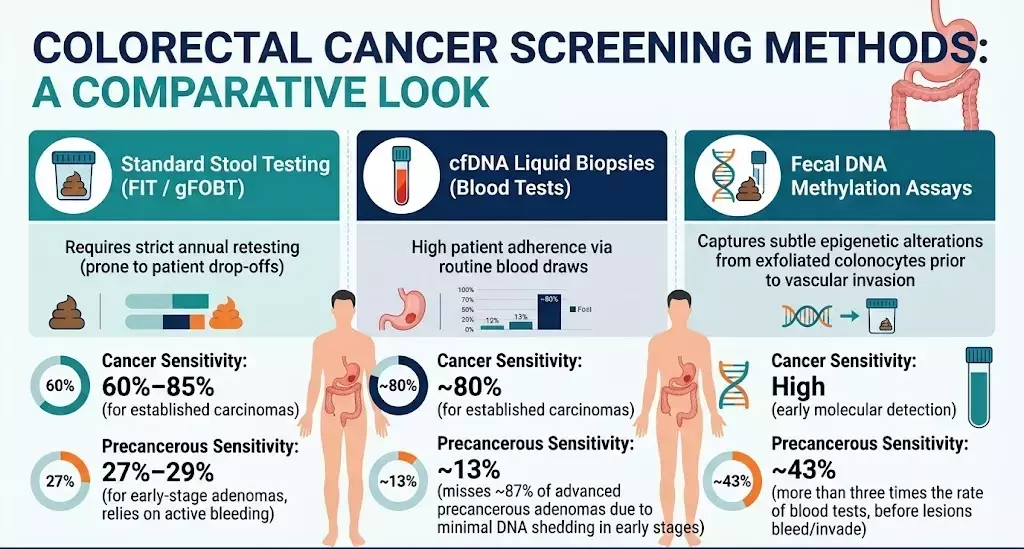
Globally, there's a growing recognition of the importance of non-invasive early detection for colorectal cancer. Regulatory bodies have increasingly approved advanced molecular tests, including multi-target stool DNA assays and emerging blood-based liquid biopsies. These approvals underscore a shift towards more accessible and efficient screening methods. The clinical efficacy of these tests, however, varies depending on their application tier.
Integrating Advanced Molecular Screening into Primary Care: A Practical Approach
For molecular screening to truly impact population-level survival rates, it must be easily implementable within primary care settings. Epigenetic assays, when designed for widespread deployment, can revolutionize clinical workflows. COLOTECT® exemplifies this by offering several key advantages:
- Proactive Biological Intervention: This test targets specific biomarkers, such as SDC2, ADHFE1, and PPP2R5C, to detect hypermethylation—a sign of cellular alterations in precancerous adenomas. This allows for detection at stages much earlier than what traditional fecal immunochemical tests (FIT) can achieve, which often only identify the disease after visible bleeding occurs.
- Enhanced Community Access: The stool collection process is non-invasive and requires no special preparation, making it pain-free and easy for individuals to complete at home. This significantly reduces the social and logistical barriers that often hinder screening compliance, particularly in rural and underserved communities.
- Optimizing Endoscopy Resources: Instead of performing colonoscopies on entire populations, health systems can use molecular testing as an initial filter. Real-world data indicates that approximately 80% of individuals with positive COLOTECT® results who then underwent a colonoscopy were confirmed to have colorectal abnormalities, demonstrating its effectiveness in directing resources to those most in need.
By incorporating non-invasive molecular testing, oncology care can transition from a reactive model to a proactive, preventative one. This approach can alleviate the burden on Latin American health systems, reduce extensive colonoscopy backlogs, shorten critical diagnostic delays, and ultimately enable the detection of CRC at stages where it is most curable, ensuring more equitable and life-saving care for all.